
Gallery
Austrian Biedermeier table clock with automaton, eye turner and calendar


Austria, probably Vienna, 1820s–1830s, veneered ebonized wooden case, four alabaster columns; carved gilded column bases, movement with anchor escapement and pendulum suspended on a silk thread, skeleton dial with an aperture revealing the striking mechanism and calendar gearing, three small dial rings subsidiary ring dials indicating calendar data (month, day of the month, and day of the week), dial with automata – two moving relief figures with an anvil and treadle grindstone (Blacksmith and Grinder), eye turner - a mascaron placed at the top, whose eyes move with the movement of a pendulum, 4/4 hour striking mechanism, repeater function, enamel dial ring with Arabic numerals, blued steel hands, overall dimensions 67 × 34.5 × 15 cm.
Other products
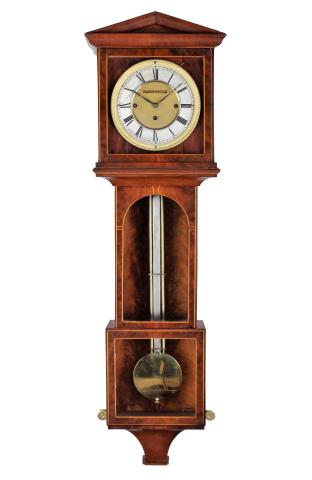
Miniature wall clock - Laterndluhr
Wall-mounted pendulum clock, so-called lantern clock, circa 1830, Vienna; dial signed I. Vlaschitz in Wn. Neustadt (Ignatz Vlaschitz in Wien Neustadt).
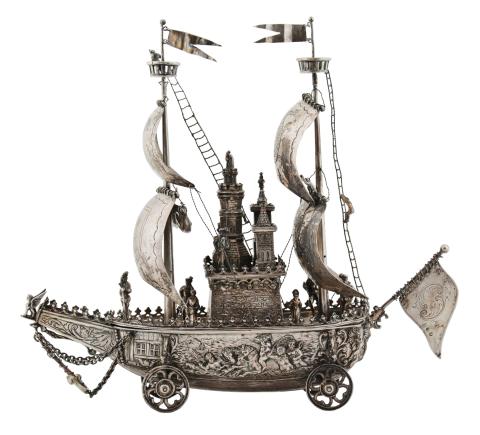
Silver model of a ship with figural decoration
Germany, Hanau, 19th century. Two-part silver model of a ship with rich figural and sculptural decoration, comprising a total of 12 figures.
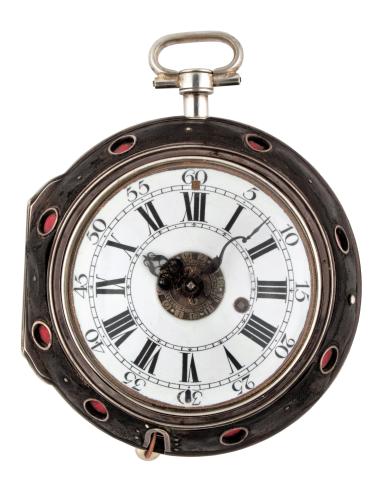
Large Baroque carriage clock – Joseph Spiegel
Germany, Friedberg, Joseph Spiegel (Joseph Miroir), circa 1740. Large double-cased traveling striking clock with date display and alarm.
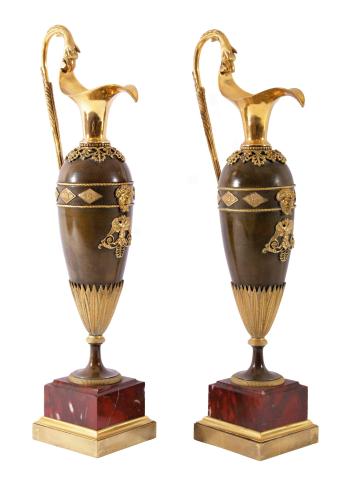
Pair of Empire teapots – Claude Galle
France, Paris, circa 1810. A luxurious pair of bronze ewers produced in the renowned workshop of Claude Galle (1759–1815).